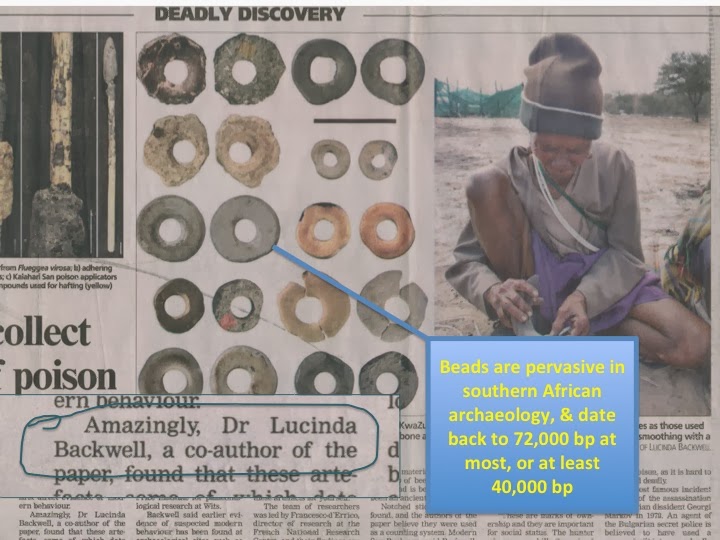
Well, I’m trying to get a schedule of conferences together for 2014, and have so far sent abstracts off to two of them
The proposal, or abstract is:
A new archaeology of
glass beads in southern Africa, 500-1200 CE
Robert Thornton (Anthropology, Wits
University, South Africa)
Jonathan Thornton (Art Conservation,
Buffalo State College, USA)
Our
experimental reconstruction of glass bead technologies, OLM, SEM, EDS, and XRF
studies of their internal structure, ethnographic evidence, and reanalysis of
archaeological materials, provides a basis for a radical reinterpretation of the
origin, trade, and production of glass beads in the archaeological record. According to the current standard
interpretation, glass beads were all traded into southern Africa from a few
sources in the Indian Ocean (‘Trade Wind’ beads), Egypt, and/or the Middle East,
and they were all either ‘wound’ (on a mandrel) or ‘drawn’ (as tubes from a
molten mass of glass). In addition, it
has been argued that beads constituted ‘wealth’ for class-stratified,
agro-pastoral societies. For instance, micro-structural evidence shows that
some (many?) beads were made of sintered powdered glass, not ‘wound’ or ‘drawn’.
Experimental reconstruction of possible
early pyrotechnologies shows that glass could have been manufactured from raw
materials plentiful in the southern African areas where glass beads are found,
and experimental reproduction of glass beads that strongly resemble
archaeological beads at K2, Mapungubwe, etc., show that glass and glass beads could
have been produced locally, possibly at many sites across southern Africa, and
probably were. Re-analysis of
ethnographic and historical evidence shows that beads in African societies were
primarily used in ritual and healing, rather than as wealth or currency. This leads to new understandings of
historical trade patterns and of social structures in first millennium African
societies implying, for instance, that Indian Ocean trade in glass beads was
multi-sited and reciprocal, involving societies structured around sacred sites with
ritual-technological specialisation, rather than (or in addition to?) class
stratification.
The second paper-to-be is proposed for the Association for Social Anthropology in Edinburgh, in June.
The proposal is:
Human sexuality and human origins: The occlusion of
sex and the exclusion of social anthropology from the human evolution debate
Robert Thornton, Anthropology, University of the
Witwatersrand
Summary
We must include a distinctly human sexuality with tool-making,
fire, language, etc., in the original human skill set that made the emergence
of Homo sapiens sapiens possible. The lack of an adequately anthropological
theory of sex has excluded social anthropology from debates on human origins.
Long Abstract
The emergence of the ‘human’ from hominidae, and of ‘human nature’ from nature, must surely have
involved the emergence of a human sexuality from a ‘natural’ sexuality. Paradigms rooted in Christian theology and
Darwinian evolution have precluded the conceptual separation of human
sex/uality from reproduction, and have therefore prevented social
anthropologists from engaging usefully with the human origins debate. A
distinctly human sexuality, however, can be clearly distinguished from the sex/uality
of other mammals by re-envisioning sex as a distinct form of social
action/agency, and by recognising that, for humans, sex and reproduction are different
forms of (social) action, even as they are often culturally conflated. Many
Enlightenment debates revolved around the utility and rationale for ‘marriage’
as a sort of proxy for human sexuality, even as they necessarily failed to
grasp the significance of the sexual. I
argue that the emergence of a specifically human sexuality, together with tool-making,
fire, language, etc., in the original human skill set, was one of the enabling
conditions for the emergence of humanity per se. If the emergence of a distinctly human,
culturally-configured sexuality can be seen as part of the original human skill
set, then sex (as social action) had already separated itself from reproduction
(and therefore natural selection). This
perspective allows social anthropology to re-enter the discussion of human
origins, and provides new perspectives on the relation between sex, religion,
and human evolution.